
Book two in the Super AI Engineering Series
Your agent forgets you exist.
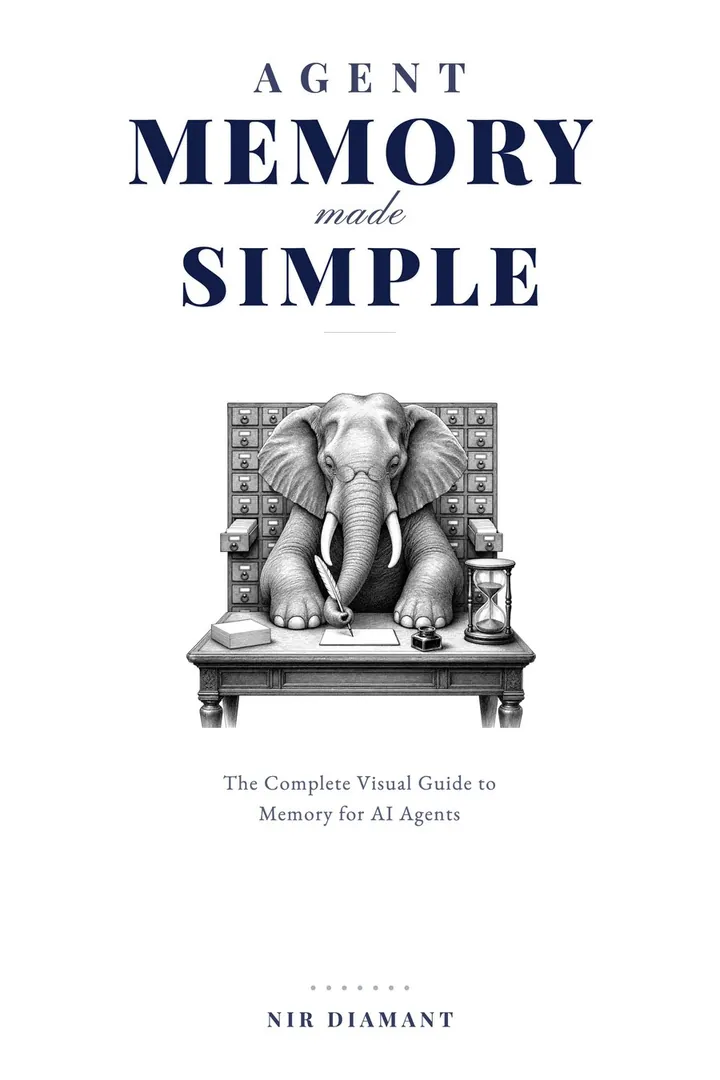
Brilliant for one conversation, amnesiac between them. Bigger context windows did not fix that and never will. This book is the complete map of agent memory: 30 techniques, 184 diagrams, not a single line of code.
Paperback · Kindle · free on Kindle Unlimited · or sample Chapter 1 first, no signup
Free on Kindle Unlimited · Amazon's standard returns
Memory is not the same thing as context
Context is what the agent is looking at right now. Memory is what it can go and get. A longer prompt costs more on every single turn, dilutes the model's attention, and still vanishes the moment the session ends. No context window, at any size, gives an agent something to remember you by next week. That is a different problem, and it has thirty techniques of its own.
30 techniques. One visual language.
From the simplest chat buffer to memory systems serving millions of users. Every chapter opens with an analogy, shows the mechanism as a diagram, and closes with the tradeoffs.
The conversation
- Conversation buffers
- Sliding windows
- Summary memory
- Summary buffers
- Token budgets
What the agent keeps
- Vector memory
- Entity records
- Knowledge graphs
- Episodic memory
- Semantic facts
- Procedural skills
Memory architectures
- Working memory and salience
- Hierarchical tiers
- Consolidation
- Compaction
- Self-reflection
- Memory routing
Time and forgetting
- Recency weighting
- Validity intervals
- Decay and reinforcement
- Deliberate deletion
Recall and coordination
- Hybrid retrieval and re-ranking
- Cross-session identity
- Shared memory across agents
- Memory exposed as tools
Systems and proof
- The operating-system model
- Build versus buy
- Evaluating memory
- Standard benchmarks
- Production patterns
Written for people shipping agents
Agent builders
You shipped something that worked in the demo and fell apart in week three. This explains why, and hands you the toolkit.
Engineers choosing an architecture
Deciding between building a memory layer and buying one. Make the call with the real tradeoffs in front of you.
Technical PMs
Understand what your team is building, and why the memory question keeps eating the roadmap, without reading twenty papers.
Why this book vs. everything else
| Compared | This Book | Framework docs | Papers | Blog posts |
|---|---|---|---|---|
| No code required | ||||
| Covers 30 techniques | ||||
| Tradeoffs stated every chapter | partial | |||
| Framework-agnostic | partial | |||
| Illustrated throughout | partial | partial |
Formats and updates
- Kindle $9.99 · free with Kindle Unlimited
- Paperback $24.99 · 6 x 9 in, 467 pages
- Hardcover $39.99 · case laminate, 467 pages
- 184 custom illustrations across 28 chapters
- A companion open-source notebook for every technique
From the creator of RAG Techniques and GenAI Agents
Nir Diamant is an AI researcher and open-source educator. His GitHub repositories have earned over 85,000 stars and draw more than 500,000 views every month. This book distils his Agent Memory Techniques repository, thirty runnable notebooks, into a visual, code-free format. His DiamantAI Newsletter reaches 40,000+ subscribers and ranks in the top 0.1% on Substack.
It follows RAG Made Simple, an Amazon bestseller in Generative AI. The two overlap in one place, retrieval, and this one assumes no knowledge of the first.
Build agents that remember.
Stop rebuilding the same memory layer badly. Get the intuition that transfers to any language, any stack, and whatever the field invents next.
All formats on Amazon as Kindle, paperback and hardcover · free with Kindle Unlimited