
They Copied a Fly's Brain Into a Computer. It Started Walking. Nobody Taught It How

Every AI system you have worked with learned its behavior from data, a loss function and gradient descent nudging weights until the model does what you want. A fruit fly never did any of that, nobody trained it, there was no reward signal, and its behavior emerged from the wiring of its brain. Researchers have now shown that if you copy that wiring into a computer, the same thing happens, the behavior emerges without training. That is not just a neuroscience story, it is a challenge to a core assumption of modern AI. AI is top-down, you set a goal, measure it, and optimize toward it, and the network's wiring is shaped entirely by training. Biology is the opposite, the wiring is set by genetics and development before the animal experiences anything, structure comes first and behavior emerges from it, and until recently there was no way to test biology's bet at scale because we had no complete wiring diagram of a complex brain.
That changed with the connectome, a complete map of every neuron and every synapse. In October 2024 an international consortium published the first complete connectome of an adult fruit fly brain in Nature, 139,255 neurons and 50 million synaptic connections, built from 7,000 brain slices imaged with electron microscopes over ten years, fully open source. A team then built a computational model of the entire brain from that map, using machine learning to predict which neurotransmitter each neuron releases, and simulated the whole network on a laptop. When they activated the sugar-sensing neurons, the model predicted exactly which downstream neurons would fire to start feeding, when they activated antenna sensors, it predicted grooming with the front legs, about 95 percent accuracy in predicting motor behavior with no training data, no reward function, and no gradient descent. The behaviors were already latent in the wiring.
Then they gave it a body, a physics-simulated fly with 87 articulated joints built from an X-ray scan, and closed the loop so sensory input flows in, signals propagate through all 139,255 neurons, motor commands come out, the body moves, and movement updates the senses. The digital fly walks toward food, stops to groom dust from its antennae, and feeds, none of it programmed, all of it emergent from the circuit, and fundamentally different from prior work that trained a policy to mimic fly movement with reinforcement learning. For builders the implications are concrete. Biological wiring could serve as a structured initialization instead of random weights, starting from millions of years of evolution rather than noise, which points toward genuine low-data learning because the architecture does work that training would otherwise have to do. It is also the most interpretable class of neural model that exists, since every connection has a biological identity you can trace a behavior back to, and it opens digital testing of drugs and therapies by intervening on a simulated circuit. The roadmap runs fly to mouse to human, and a mouse brain has about 560 times more neurons, so the scaling is hard, but the approach is now proven, and it forces a question the field has avoided, what if the right structure is doing most of the work.
TL;DR
A complete fruit fly connectome, copied into a computer, produced walking, grooming, and feeding with no training at all, a direct challenge to the assumption that intelligence has to be learned from data.
Key Takeaways
A fruit fly's behavior comes from the wiring of its brain, not from training, and researchers showed that copying that wiring into a computer reproduces the behavior with no learning at all.
The first complete adult fruit fly connectome (139,255 neurons, 50 million synapses, published in Nature, October 2024) was turned into a laptop-scale model that predicted feeding and grooming at ~95% accuracy with zero training data.
Connected to a physics-simulated body of 87 joints, the model walks toward food, grooms, and feeds as emergent behavior, distinct from reinforcement-learning approaches that train a policy to imitate movement.
For AI this suggests biological wiring as a structured initialization instead of random weights, a path to genuine low-data learning, and the most interpretable class of neural model that exists.
Hi Folks,
Here is the question I want you to sit with as you read this:
Every AI system you have ever worked with learned its behavior from data. You define a loss function, run gradient descent, and the model adjusts its weights until it does what you want. That is how every LLM works. That is how every reinforcement learning agent works.
But a fruit fly never did any of that. Nobody trained it. No reward signal. No labeled examples. The behavior emerged from the wiring of its brain.
Researchers just demonstrated that if you copy that wiring into a computer, the exact same thing happens. The behavior emerges. Without training.
That is not just a neuroscience story. It is a direct challenge to one of the core assumptions of modern AI.
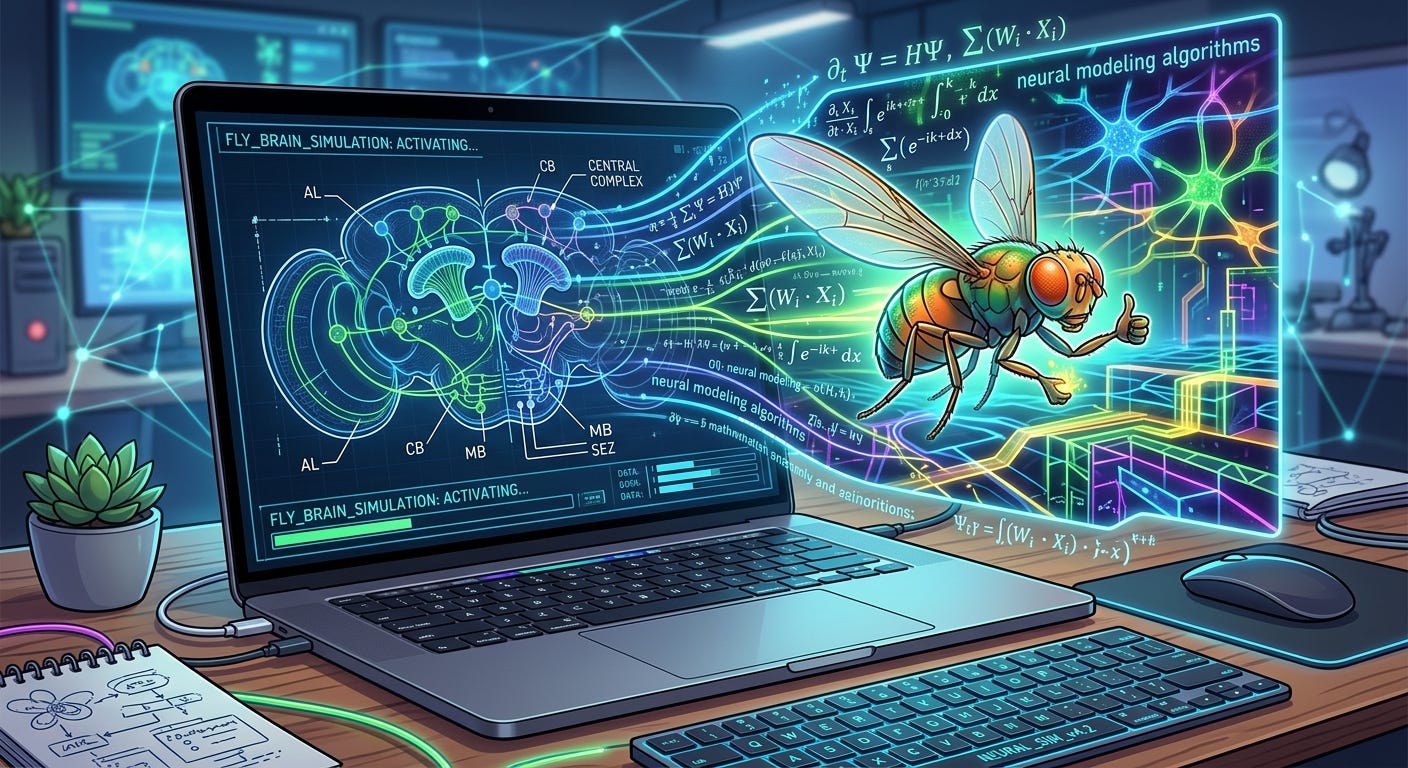
Two Theories of Intelligence
Modern AI is fundamentally top-down. You have a goal, you measure it, and you optimize toward it. The wiring of the network gets shaped entirely by the training process.
Biology does the opposite. The brain’s wiring is determined by genetics and development before the animal ever experiences the world. Structure comes first. Behavior emerges from it.
AI’s bet: wire up a flexible system, expose it to enough data, and intelligence will emerge from optimization.
Biology’s bet: build the right wiring diagram, and intelligence is already latent in the architecture.
Until recently, we had no way to test biology’s approach at scale. We did not have complete wiring diagrams for any complex brain. That just changed.
What They Built
A connectome is a complete wiring diagram of a brain. Every neuron. Every synapse. Every connection, labeled excitatory or inhibitory.
In October 2024, an international research consortium published the first complete connectome of an adult fruit fly brain in Nature. It took 10 years and 7,000 brain slices imaged with electron microscopes. The result: 139,255 neurons and 50 million synaptic connections, fully open source.
A team of researchers then built a computational model of the entire brain from that map, using machine learning to predict what neurotransmitter each neuron releases. They simulated the whole network.
It ran on a laptop.
When they activated the neurons that sense sugar, the model predicted exactly which downstream neurons would fire to initiate feeding. When they activated sensory neurons in the antennae, the model predicted grooming behavior with the front legs. Exactly what a real fly does. 95% accuracy in predicting motor behavior. No training data. No reward function. No gradient descent.
The behaviors were already in the wiring.
Giving It a Body
The brain model had outputs with nowhere to go. No muscles. No physics. A conductor with a full orchestra score and no musicians.
The next step: connect the brain model to a physics-simulated fly body, 87 independently articulated joints built from an X-ray scan of a real fruit fly. Then close the loop. Sensory input flows in, signals propagate through all 139,255 neurons, motor commands come out, the body moves, and movement updates the sensory state. Repeat.
The digital fly walks toward food, stops to groom dust off its antennae, then resumes and feeds.
Nobody programmed those behaviors. They emerged from the circuit.
This is fundamentally different from recent AI work where a simulated fly body learned to walk via reinforcement learning. That approach trains a policy to mimic biological movement. This approach copies the biological wiring and lets the movement come from it. The difference is between a stunt double who studied your walk, versus making a copy of your nervous system and watching it walk on its own.
What This Means in Practice
This is where it gets relevant for builders.
Biological architectures as initialization, not just inspiration. Right now, neuroscience influences AI mostly as metaphor. Transformers were loosely inspired by attention in the brain, but “inspired by” is very different from “derived from.” This research shows that a connectome-derived architecture used directly as a network structure produces coherent behavior before any learning happens. The practical question for AI researchers: what if biologically accurate wiring diagrams were used as structured initializations instead of random weights? You would be starting from millions of years of evolutionary optimization, not from noise.
A new path to low-data regimes. One of the hardest problems in applied AI is good performance with limited training data. Current models need enormous datasets because they learn everything from scratch, including structure. A connectome-constrained model starts with structure already encoded. It needs far less data to produce meaningful behavior because the architecture is doing work that training would otherwise have to do. This matters directly for domains where labeled data is scarce: rare disease research, robotics in novel environments, edge deployments with minimal compute.
Mechanistic interpretability, for real. The AI safety field has spent years trying to understand what is happening inside large models. It is hard because the structure of modern networks carries no inherent meaning. In a connectome-based model, every connection has a biological identity. You know what neuron type it is, what neurotransmitter it uses, what circuit it belongs to. When a behavior emerges, you can trace it back through the graph to the specific connections that produced it. That is not a partial explanation. It is a complete causal account. If interpretability is something you care about, this is the most interpretable class of neural model that exists.
Drug and therapy development. A working simulation of a biological brain circuit means you can test interventions digitally before touching a patient. Introduce a simulated neurotoxin. Block a specific receptor type. Sever a connection. Watch what behavior changes. This compresses the earliest stages of drug discovery dramatically, and gives researchers hypotheses they can trace back to mechanism. As the approach scales toward mammalian brains, it becomes one of the most valuable tools in pharmaceutical research.
The Bigger Point
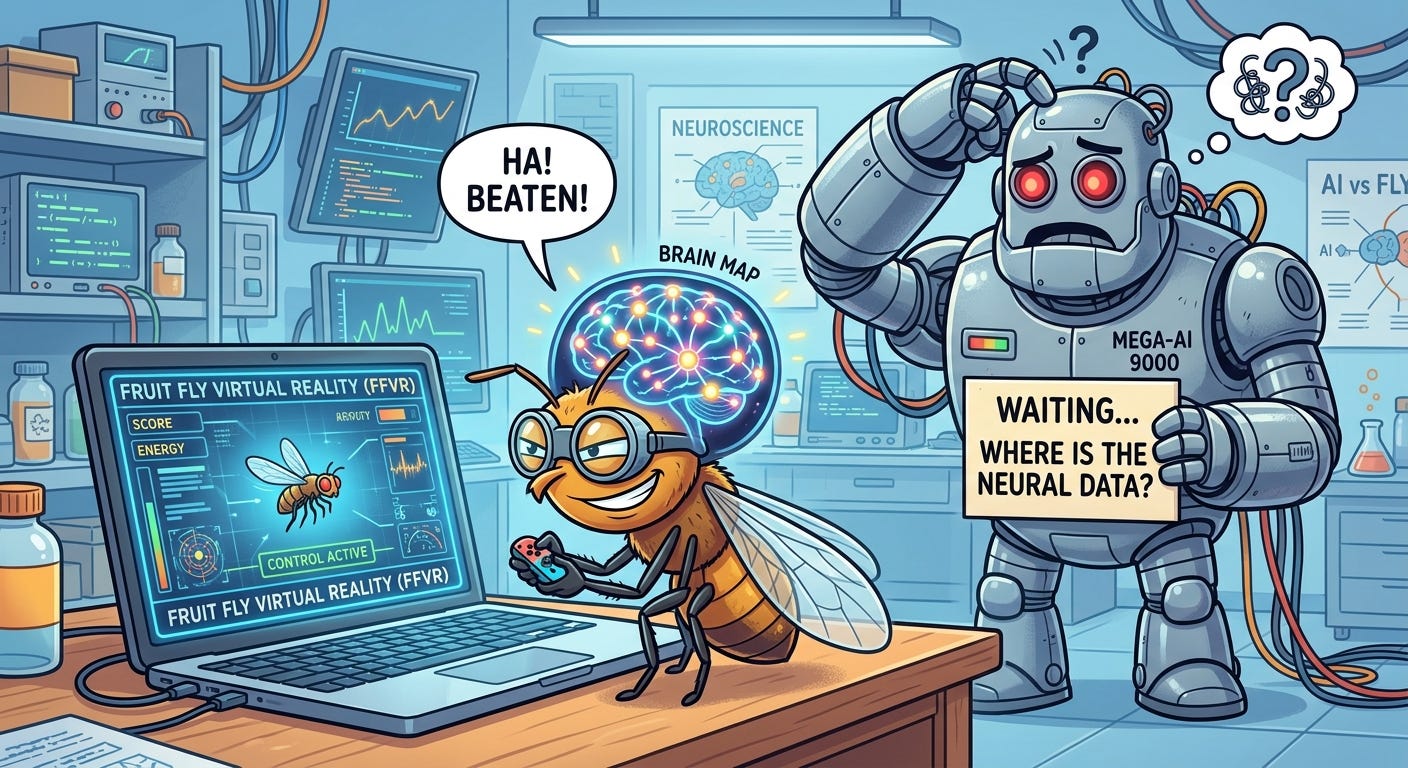
The roadmap from here goes fly, mouse, human. A mouse brain has 70 million neurons, about 560 times more than the fly. The scaling is hard. But the approach is now proven.
More importantly, this research forces a question the field has not had to take seriously before: what if the right structure is doing most of the work, and we have been over-crediting optimization this whole time?
Modern AI runs almost entirely on the assumption that training is where intelligence comes from. This is the clearest demonstration yet that structure alone is enough to produce real behavior in a complex system.
The most interesting work in the next decade will probably sit at the intersection of both. Not connectome models versus learned models, but what happens when you combine structural priors from biology with the optimization power of machine learning. Start from the right architecture. Then learn.
A fly is walking around in a physics simulation right now because someone mapped its neurons and ran the circuit. No training loop. No reward signal. Just structure, and the behavior was already there.
Related Tutorials
Free Resources
Download free guides, cheatsheets, and templates curated from 130+ tutorials on RAG, AI Agents, and Prompt Engineering.
Browse Free ResourcesAlso available on Substack
Prefer Substack? This article is also on our newsletter, read by 40K+ AI engineers.
Related Articles
The AI Arms Race Is Over. Smart Engineering Won
The era of scaling compute is ending. What's replacing it is smarter engineering, better architectures, evaluation, and deployment patterns.
Why AI Experts Are Moving from Prompt Engineering to Context Engineering
Context engineering is the new frontier, going beyond prompts to control the entire information environment around your AI system.
AI Deep Research Explained
How AI deep research tools work, from multi-step reasoning to iterative search and synthesis. A technical breakdown of the emerging research agent pattern.
Get More AI Insights Weekly
Join 40K+ AI engineers getting deep dives on agents, RAG, and prompt engineering every week.